· Ascenium · Technical · 6 min read
DSE using OpenROAD: A strategic advantage

The Ascenium Strategy for next-generation General Processors
At Ascenium, design space exploration (DSE) is not treated as a late-stage tuning activity. It is the primary mechanism by which architectural decisions for a general-purpose processor are validated before they harden into product commitments.
For processors intended to span diverse workloads, memory systems, and operating points, the central risk is not local inefficiency—it is architectural overfitting. Designs optimized against a narrow set of assumptions often fail once physical constraints, workload diversity, or scaling pressures are introduced. Avoiding this failure mode is the strategic motivation behind Ascenium’s use of DSE.
With guidance and strong support from Precision Innovations, OpenROAD is used to make architectural tradeoffs visible early, when flexibility still exists and design costs are minimal.
From Point Solutions to Architectural Coverage
The strategic value of DSE lies in exploring regions of feasibility, not in identifying a single optimal design point.
Rather than asking “What is the best configuration?”, Ascenium uses DSE to understand:
- Which architectural parameters are robust across workloads
- Which tradeoffs are structural rather than incidental
- Where physical constraints override architectural intent
This shift—from point optimization to coverage—changes how architecture is evaluated. It prioritizes elasticity and robustness over peak metrics, which is essential for general-purpose compute architectures expected to evolve across product variants and technology nodes.
The Key Signal: Clock Cycles vs. Power
The most compact expression of these tradeoffs is the relationship between execution cost and power.
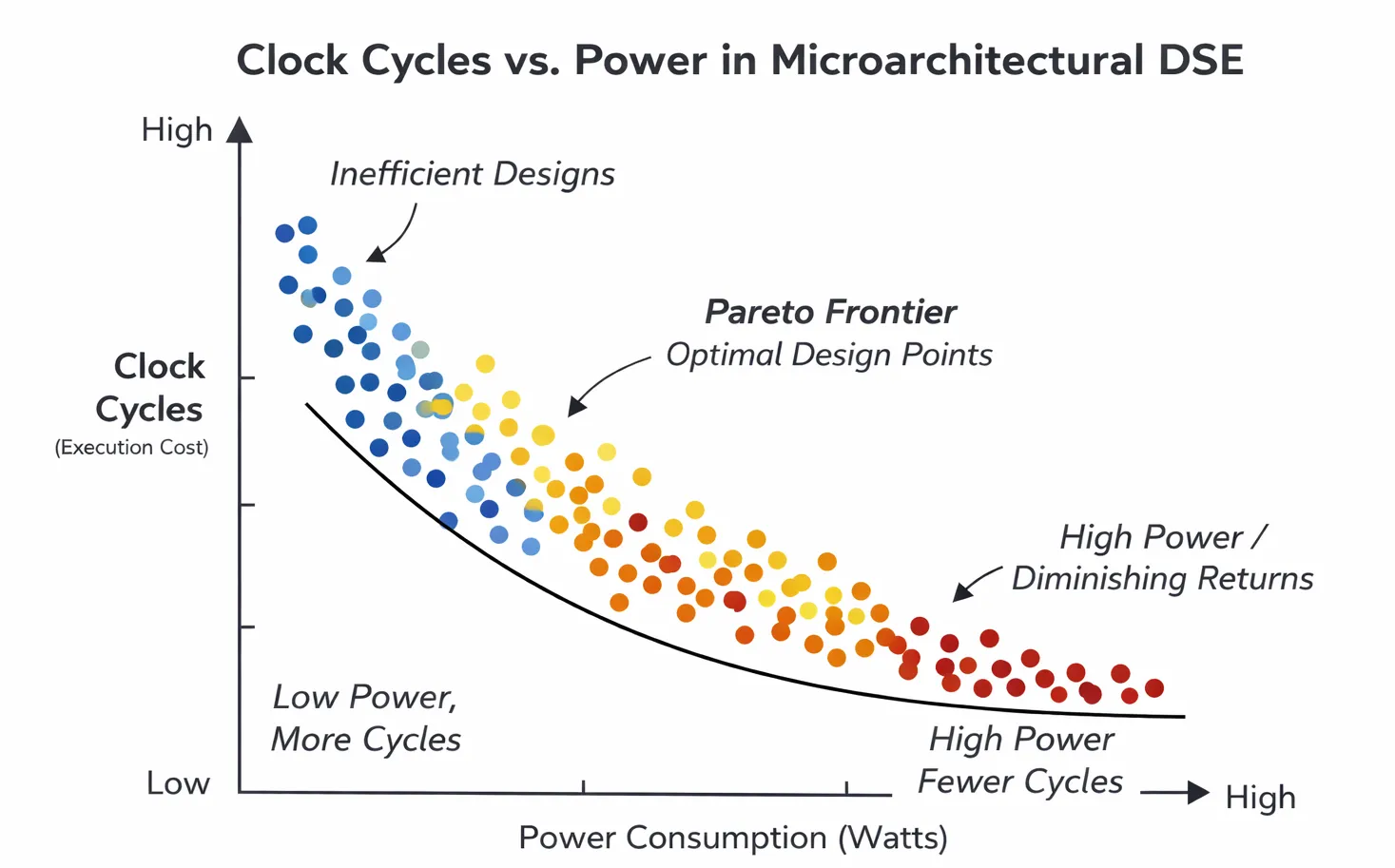 Fig: Clock cycles vs Energy consumption DSE with Pareto frontier analyses for optimal tradeoffs
The above figure showing execution clock cycles versus power plot, provides a compact view of the fundamental tradeoffs explored during microarchitecture design space exploration. Each point represents a different processor design evaluated on the same workload, where finishing work in fewer clock cycles generally requires more hardware activity and therefore higher power. The curved boundary of the plot highlights the most efficient tradeoffs, separating strong design options from those that consume more power without delivering meaningful performance gains. The shape of this curve is especially important: early design changes often produce large performance improvements at modest power cost, while later changes deliver diminishing returns as physical limits begin to dominate. Rather than pointing to a single “best” design, the figure shows which architectural directions remain practical and scalable as requirements evolve.
Thus Pareto relationship is the strategic signal. It reveals where performance gains demand disproportionate power, where architectural changes saturate, and where physically fragile regions emerge. These observations directly inform which architectural directions remain viable as requirements evolve.
Why OpenROAD Changes the Strategic Equation
Physically informed DSE is traditionally constrained by tool cost, limited parallelism, and opaque heuristics. These constraints force exploration to focus on a small number of hand-picked configurations, increasing the risk of architectural blind spots.
OpenROAD alters this equation.
Because it is open, scriptable, and scalable, Ascenium can explore breadth first rather than depth first. This enables:
Early elimination of physically weak architectural regions
Confidence that surviving candidates are not artifacts of tooling
Exploration at a scale where trends, not anecdotes, dominate decisions
In this context, OpenROAD functions less as a backend implementation tool and more as a risk-reduction instrument for architectural strategy.
Why Ranking Matters More Than Absolute Accuracy
A recurring theme in Ascenium’s workflow is that relative ordering across design points matters more than absolute values.
The combination of OpenROAD with ASAP7 produces results that correlate strongly with commercial flows in terms of ranking, even when absolute PPA numbers differ. For DSE, this is the critical property. Architectural decisions hinge on understanding:
- which parameters materially affect outcomes,
- which effects are second-order, and
- where diminishing returns begin.
These are strategic questions, not signoff questions.
Multi-Objective, Multi-Fidelity Exploration
To make this exploration tractable, DSE is structured as a ladder of increasing fidelity—from fast, approximate evaluations to full synthesis, placement, clock tree synthesis, and global routing.
This staged approach allows large portions of the search space to be pruned early, reserving expensive physical analysis for promising regions. Without this multi-fidelity structure, systematic exploration across microarchitecture, memory hierarchy, and physical constraints would be infeasible.
Workload-Aware Power Estimation
Power estimation is performed using real workloads rather than synthetic activity factors. Switching activity can be collected over entire applications or targeted execution regions, enabling workload-sensitive comparisons between closely related design points.
This is particularly important when evaluating microarchitectural features whose impact may be localized rather than uniform
An intractable Search Space no more
The practicality of this approach depends on:
- Robust automation that executes reliably across thousands of configurations
- Sufficient speed to keep architectural exploration interactive
- Parallel execution and efficient re-use of shared build results enabled via bazel-orfs
- Absence of licensing constraints that would otherwise cap scale
- Precision Innovation commercial support
Without these properties, DSE would collapse under computational or economic limits.
Precision Innovation support is critical to make the search space tractable: use-case specific optimizations, bug fixes and support is needed to ensure that the optimization function can actually return a result in a timely manner for a wide range of architectural parameters.
The DSE search algorithms are much more effective when the optimization function works without supervision and also beyond interesting architectural parameters as it helps to create a gradient and makes the search more efficient. Without Precision Innovation the search space has to be pruned for architectural parameters where no measurement is available and the algorithm is essentially blind in these regions. A partial optimization function leads to suboptimal pareto fronts and strategic mistakes in identifying strong and weak points of the architecture.
System-Level Context
Architectural evaluation is grounded in SPEC CPU2017 workloads, combined with SimPoint analysis and a spectrum of memory subsystem models using Ramulator, spanning DDR and HBM configurations alongside parameterized L1–L3 cache hierarchies. Recall that ranking is more important than accuracy when searching for an architectural product pareto front.
This stands in contrast to full-system RTL simulation approaches such as FireSim, which provide highly accurate measurements for configurations that are accurate, but obsolete to realize as product silicon. Cycle accuracy comes with a risk: overfitting. There could be a “cliff” in the next generation RAM that is 5 cycles faster or slower than the cycle accurate previous generation. DSE instead emphasizes breadth and robustness over point accuracy.
Why This Matters
For Ascenium, robust DSE is a prerequisite not only for architectural confidence, but for credible downstream planning. The results constrain achievable performance envelopes, power targets, and engineering risk before committing to the substantial cost and effort of tapeout and productization.
In that sense, OpenROAD-enabled DSE is not merely a technical workflow—it is a strategic foundation for building general-purpose processors that are scalable, physically grounded, and resilient to change.